Nitrate (NO₃⁻) is widely recognized as one of the most critical nutrients regulating biological productivity in marine ecosystems. Since the pioneering work of Alfred C. Redfield and colleagues, nitrate has been identified as a primary limiting factor for phytoplankton growth across large regions of the global ocean. Its availability directly influences primary production, carbon cycling, and overall marine food web dynamics.
In the euphotic zone the upper layer of the ocean where sunlight supports photosynthesis nitrate concentrations typically range from extremely low levels (~0.1 µM) in oligotrophic waters to values exceeding 20 µM in regions affected by upwelling. These gradients are highly dynamic and can change rapidly due to physical processes such as mixing, internal waves, and nutrient transport. Consequently, there is a strong need for analytical techniques that allow rapid, accurate, and continuous measurement of nitrate concentrations in seawater.
Traditional methods for nitrate determination rely on chemical reduction followed by colorimetric detection. However, the increasing demand for high-resolution oceanographic data has driven the development of automated and more efficient analytical approaches. Among these, flow injection analysis (FIA) has emerged as a powerful technique for real-time monitoring of nitrate and nitrite in marine environments.
The classical method for nitrate analysis involves its reduction to nitrite using a cadmium-based reduction column. Once reduced, nitrite is quantified through a colorimetric reaction that produces an azo dye. This dye forms via a diazotization reaction involving sulfanilamide and subsequent coupling with N-(1-naphthyl)ethylenediamine (NED), resulting in a colored compound measurable by spectrophotometry.
This methodology, described in detail by researchers such as T. R. Parsons, has been widely adopted and integrated into segmented continuous flow analyzers (also known as autoanalyzers). These systems enable automated processing of multiple samples and have been extensively used in marine chemistry.
Despite their reliability, conventional segmented flow systems present several limitations:
These drawbacks have motivated the exploration of alternative techniques that offer higher efficiency and operational simplicity.

Flow Injection Analysis (FIA), introduced and developed by Jaromir Ruzicka and Elo Hansen, represents a major advancement in automated chemical analysis. Unlike segmented flow systems, FIA does not require air segmentation. Instead, discrete volumes of sample or reagent are injected into a continuously flowing carrier stream.
This design provides several key advantages:
Because of these benefits, FIA is particularly suitable for in situ oceanographic measurements, where reliability and speed are essential.
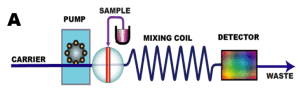
Although FIA offers significant improvements, it also presents certain limitations. One of the main challenges is that chemical reactions within the flow system often do not reach completion. This is due to the relatively short residence time of the sample within the reaction manifold.
In earlier work by L. Anderson, FIA was applied to nitrate and nitrite determination with a detection limit of approximately 0.1 µM. However, achieving this sensitivity required extending the reaction time, which in turn reduced the sampling rate to about 30 samples per hour. This trade-off between sensitivity and throughput limits the overall efficiency of conventional FIA systems.
To overcome this limitation, modifications to the FIA methodology have been proposed.

An improved version of FIA, known as reverse flow injection analysis (rFIA), has been developed to enhance both sensitivity and sampling speed. In contrast to traditional FIA—where the sample is injected into a reagent stream—rFIA involves injecting reagents into a continuously flowing sample stream.
This seemingly simple modification leads to several important improvements:
Using rFIA, it becomes possible to analyze seawater samples at rates up to 2.5 times higher than earlier FIA methods, while maintaining a detection limit of 0.1 µM. This makes rFIA particularly suitable for high-resolution environmental monitoring.

The analytical system for nitrate and nitrite determination consists of several integrated components:
The reaction manifold is constructed using polytetrafluoroethylene (PTFE) tubing with small internal diameters to ensure controlled flow and efficient mixing. A peristaltic pump drives the flow of seawater samples and reagents through the system.
Careful optimization of tubing length is critical to:
The reduction of nitrate to nitrite is achieved using a copperized cadmium column. The efficiency of this column is initially close to 100%, although it gradually decreases over time due to surface degradation.
Key observations include:
This highlights the importance of regular calibration and maintenance.

The determination of nitrate involves three sequential reactions:
The intensity of the resulting color is proportional to the original nitrate concentration and is measured spectrophotometrically.

The residence time defined as the duration between reagent injection and signal detection plays a crucial role in determining sensitivity. Increasing residence time enhances reaction completion but reduces throughput.
Experimental findings indicate:
An optimal balance must be achieved depending on analytical requirements.
The reduction step was found to be nearly 100% efficient across a range of flow rates. Similarly, the diazotization reaction reached completion under standard conditions.
However, the final coupling reaction requires sufficient time to reach completion. Maximum signal intensity is achieved at residence times of approximately 3 minutes, although shorter times can be used with acceptable sensitivity loss.
A key feature of this method is the use of a low-cost LED-based photometric detector. This system includes:
Advantages of this detector include:
However, due to the non-monochromatic nature of LED light, slight deviations from Beer’s law may occur at higher concentrations.

The method demonstrates excellent analytical performance:
These values indicate high precision across a wide concentration range.
The optimized system allows:
Duplicate analysis is essential to avoid errors caused by sample mixing and carryover effects.
The rFIA method has been successfully applied during oceanographic cruises, demonstrating its robustness under real-world conditions. During field deployments:
Occasional blockages caused by particulate matter were easily resolved, highlighting the system’s practicality.

High-resolution measurements revealed significant spatial and temporal variability in nitrate concentrations. For example:
These observations underscore the importance of high-frequency analytical techniques in understanding ocean dynamics.

The application of flow injection analysis, particularly in its reverse configuration, represents a significant advancement in the determination of nitrate and nitrite in seawater. By combining high sensitivity with rapid sampling capabilities, this technique enables detailed monitoring of nutrient dynamics in marine environments.
The method’s robustness, cost-effectiveness, and adaptability make it especially valuable for oceanographic research, where continuous, real-time data acquisition is essential. As marine science continues to address global challenges such as climate change and ocean productivity, advanced analytical tools like rFIA will play a crucial role in expanding our understanding of biogeochemical processes.
